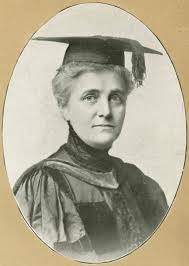
 Martha Foote Crow (May 28, 1854 – January 1, 1924) was a trailblazing American educator, poet, scholar, pioneer in higher education, and early science-fiction author.
Queer Places:
Syracuse University, 900 S Crouse Ave, Syracuse, NY 13244, United States
Wellesley College (Seven Sisters), 106 Central St, Wellesley, MA 02481
University of Chicago, 5801 S Ellis Ave, Chicago, IL 60637, United States
Northwestern University, 633 Clark St, Evanston, IL 60208, United States
Oakwood Cemetery, 940 Comstock Ave, Syracuse, NY 13210, United States
Martha Foote Crow (May 28, 1854 – January 1, 1924) was a trailblazing American educator, poet, scholar, pioneer in higher education, and early science-fiction author.
Born in Sackets Harbor, New York, on September 14, 1854, she was the daughter of the Reverend John Bartlit Foote and Mary Pendexter (Stilphen) Foote. She dedicated her life to expanding intellectual opportunities for women and establishing a prominent academic and literary footprint during an era of sweeping social change.
Crow graduated from Syracuse University, earning her Ph.B. in 1876 and later receiving her Ph.D. in 1885. Notably, she served as the first national president of the Alpha Phi sorority.
On August 7, 1884, she married Dr. John McClusky Crow (1846–1890), an archaeologist, educator, and professor of Greek at Iowa College (Grinnell College). The couple had one daughter, Agatha Crow, born in 1888. Tragically, both her husband and daughter passed away young—John in 1890 and little Agatha in 1890 as well.
Before stepping into her major university roles, Crow served on the faculties of Ives Seminary, Waynesburg College, and Wellesley College, and became a principal at Grinnell College in 1884.
In 1891, she was sent by the National Bureau of Education to investigate conditions concerning the higher education of women in Great Britain and other European countries.
She served as an assistant professor of English literature at University of Chicago during the vibrant early years of the institution from 1892 to 1900.
She later advanced her administrative and academic leadership by serving as an assistant professor of English and the dean of women at Northwestern University from 1900 to 1905.
In addition to her scholarly and administrative output, Crow was an active public lecturer and a prominent member of literary organizations, including the Browning Society, the League of American Pen Women, the Poetry Society of America, and the General Federation of Women's Clubs.
Her diverse published works span literary history, biography, poetry, sociology, and early speculative fiction: Elizabethan Sonnet Cycles (1896), The World Above: A Duologue (1905) — remembered especially as an early contribution to science-fiction writing, Elizabeth Barrett Browning (1907), Harriet Beecher Stowe, a Biography (1913), The American Country Girl (1915), Lafayette (1916), Christ in the Poetry of Today (1917).
Martha Foote Crow's life was a definitive embodiment of the "New Woman" ideal of the late 19th and early 20th centuries—financially independent, highly educated, and professionally driven. These women often forged autonomous domestic and professional spaces, frequently living in alternative household structures that subverted traditional patriarchal marriage norms.
During the 1890s, following her return to academic life and her years as a widow, Crow lived as a friend and boarder in the Chicago home of Harriet Brainard (later Harriet Brainard Moody). Their shared domestic arrangement reflected the era's supportive female networks, where independent professional women created rich intellectual environments together.
It was inside Harriet's household—heavily influenced by Crow's presence and academic standing—that Crow introduced Harriet to the poet and playwright William Vaughn Moody. This introduction anchored Harriet into the heart of Chicago's avant-garde literary scene, which she would continue to cultivate for decades through her salons and establishments like Le Petit Gourmet.
While mainstream history often highlights the later marriage between Harriet Brainard and William Vaughn Moody, the dense network of female companionship that characterized the lives of Crow and Brainard falls under the umbrella of histories of female intimacy and "Boston marriages."
For academic women of the late 19th century, living arrangements shared exclusively with other women offered a primary framework for emotional and domestic autonomy. These autonomous spaces laid the crucial structural and social foundations for what modern LGBTQ+ history recognizes as vital historical precursors to queer kinship, allowing pioneering women to live, work, and thrive outside the bounds of traditional heterosexual structures.
Mrs. Crow maintained her home in Chicago, Illinois, where she remained active in literary and scholarly circles until her passing. She died on January 1, 1924, and was buried on January 3, 1924, leaving behind a rich legacy as an educator, pioneering administrator, author, and foundational figure in women's professional independence.
References:
Support this project
This website is a passion project researched, developed, and funded entirely by me. If you find the content valuable and would like to help support the ongoing research and hosting costs, any contribution is deeply appreciated.
Thank you for keeping this independent resource alive!
My books on Amazon: Elisa Rolle's books